The Protein Data Bank: 55 years of open protein structures, and the archive behind AlphaFold
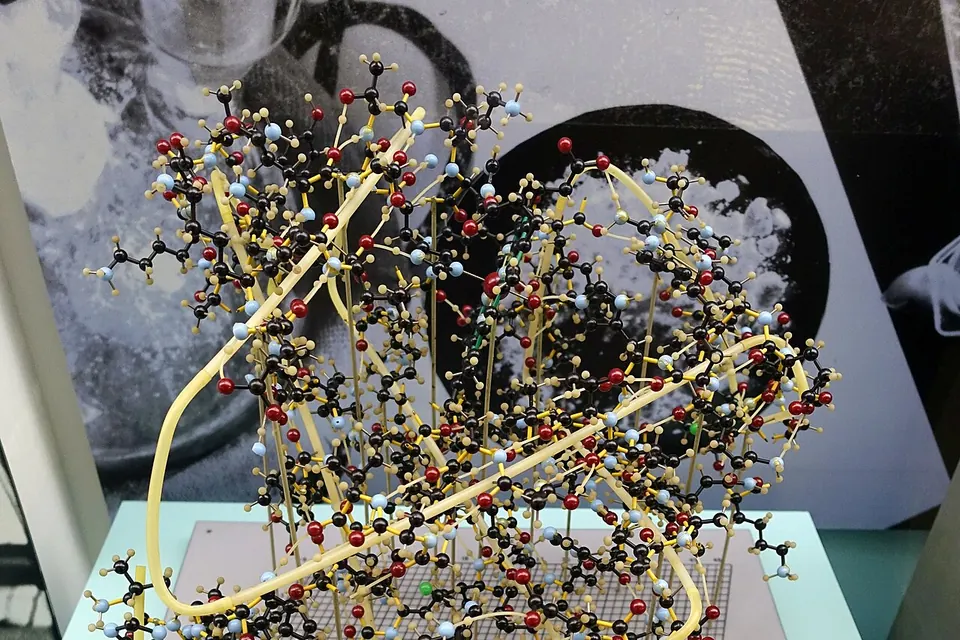
When the 2024 Nobel Prize in Chemistry rewarded the prediction of protein structures by artificial intelligence, much of the attention went to the algorithms. Behind them sits a much older piece of shared infrastructure: the Protein Data Bank, a public archive of three-dimensional molecular structures that has accepted deposits from laboratories around the world since 1971, and has always given them away.
What the archive holds
Proteins are chains of amino acids that fold into precise shapes, and the shape largely determines what a protein does: carry oxygen, cut DNA, let a virus into a cell. Structural biologists determine those shapes experimentally, mostly by X-ray crystallography, nuclear magnetic resonance (NMR) or, increasingly, electron cryo-microscopy. The result of each study is a set of atomic coordinates, plus the experimental data and descriptive information needed to judge it.
The Protein Data Bank, usually shortened to PDB, is where those results go. Each entry receives an identifier, such as 8Y9M, which journal articles cite and which anyone can use to download the structure, view it in a browser or feed it to software. On 19 November 2026, a count through the public search service of the US data centre, RCSB PDB, returned 263,157 released entries determined experimentally. The archive covers proteins, nucleic acids such as DNA and RNA, and large assemblies of both.
From seven structures to a global partnership
According to RCSB PDB's history page, the archive was established in 1971 at Brookhaven National Laboratory in the United States, under the leadership of Walter Hamilton, and originally contained 7 structures. Its creation was announced in Nature New Biology that year. Management later passed to the Research Collaboratory for Structural Bioinformatics, led by Helen Berman, which still runs the US node.
In 2003 the archive became formally international. The Worldwide Protein Data Bank (wwPDB) was set up by agreement between the US centre, the Protein Data Bank in Europe at EMBL's European Bioinformatics Institute near Cambridge, and Protein Data Bank Japan at Osaka University. The Biological Magnetic Resonance Data Bank, which archives NMR data, joined later, and the current charter, in force since 1 January 2021, also covers the Electron Microscopy Data Bank. Protein Data Bank China, based at the National Facility for Protein Science in Shanghai, joined as an associate member in 2022.
The design is unusual for an international database. The wwPDB's own FAQ explains that the members agreed to a single "archive keeper": RCSB PDB has sole write access to the archive and hands out identifiers to all deposition sites, so that the archive remains "single and uniform". Depositors can submit through any centre, using a common system called OneDep, and every site distributes the same files, while each builds its own search tools and visualisations on top. Funding is national: the FAQ lists US science agencies for RCSB PDB, EMBL, the Wellcome Trust, UK research councils and the European Union for PDBe, and the Japan Science and Technology Agency for PDBj.
The arrangement resembles other infrastructures described on this site, such as GBIF, where national nodes publish to one global index. The difference is that the PDB does more than aggregate: its staff check each deposit, a task called biocuration, and attach a validation report before release.
Who deposits, and how much
The wwPDB publishes deposition statistics by year and by data centre. They include theoretical models and entries later withdrawn or made obsolete, so they are slightly higher than the count of released structures, but they show the trend clearly.
| Year | Depositions |
|---|---|
| 2000 | 2,940 |
| 2010 | 8,878 |
| 2020 | 15,436 |
| 2025 | 20,975 |
| 2026 (to 10 November) | 20,084 |
Annual deposits have roughly multiplied by seven in a quarter of a century. The same table shows a geographical shift. In 2000, 2,407 of the 2,940 depositions went to the US centre and only 10 to Japan. In 2025, RCSB PDB received 8,528 depositions, PDBj 7,053 and PDBe 5,394, and Protein Data Bank China processed 4,471 entries, most of them deposited through the Asian site. The archive is still global, but its centre of gravity is no longer only in North America and Europe.
Open by default, in the strictest sense
The wwPDB's usage policy is short: data files in the PDB archive are available under the CC0 1.0 public domain dedication. Users are encouraged to credit the original authors but are not required to. There is no registration, no fee and no restriction on commercial use, which is why the files turn up in teaching software, drug discovery pipelines and hundreds of other databases.
Openness is reinforced by the publishing system. The wwPDB maintains recommended instructions for journals, and journals that publish macromolecular structures generally expect the data to be deposited, so that a published structure can be checked by anyone. This is the model that the UNESCO Recommendation on Open Science holds up for other fields; our explainer on open science and the SDGs describes what that recommendation asks of countries.
For 55 years, a structure solved in one laboratory has become, within weeks, raw material for every other laboratory in the world.
The archive behind AlphaFold
The 2024 Nobel Prize in Chemistry went half to David Baker "for computational protein design" and half jointly to Demis Hassabis and John Jumper "for protein structure prediction", according to the Nobel Foundation. The prediction system, AlphaFold, was trained on experimental structures from the PDB: decades of openly archived results provided the examples from which a model could learn how sequences fold.
The predictions themselves are now distributed through a separate resource. The AlphaFold Protein Structure Database, run by EMBL-EBI with Google DeepMind, offers more than 200 million predicted structures, covering nearly all proteins catalogued in the UniProt sequence database. Predicted models complement the PDB rather than replace it: they are estimates, with confidence scores, while PDB entries rest on experimental measurements that are themselves used to test and improve predictions.
A format change in 2027
Success creates a practical problem: four characters do not offer unlimited identifiers. The wwPDB's page on extended PDB IDs announces that from 21 July 2027, new entries will receive 12-character identifiers, the prefix pdb_ followed by eight characters, and will be released only in the PDBx/mmCIF and PDBML formats, without the legacy PDB file format. Existing entries keep working: 1ABC becomes pdb_00001abc, and their digital object identifiers do not change. Anyone who maintains software or teaching material that assumes four-character codes has until then to adapt.
Where the SDGs come in
The PDB is not tied to a single goal, but it serves several. Structures of pathogen proteins underpin work on vaccines and treatments that falls under SDG 3 on health; enzymes and plant proteins feed research on crops and food systems. Above all, it is a working example of SDG target 17.6, which calls for international cooperation on and access to science, technology and innovation, and for better knowledge sharing. A researcher in a country without a structural biology facility can download the same data as a laboratory next to a synchrotron, and can deposit their own results on equal terms. Large instruments such as the SESAME synchrotron in Jordan show the expensive end of structural science; the PDB shows how its output can be shared at almost no cost to the user.
The limits are those of the data. Structures reflect what laboratories chose to study and could afford to measure, so well-funded research questions and model organisms are over-represented. Open access to results does not equalise access to the instruments that produce them.
Sources
- Worldwide Protein Data Bank, Frequently Asked Questions (archive keeper, single archive, funding), together with the wwPDB home page, charter, usage policy (CC0 1.0) and deposition statistics by year and site (last updated 10 November 2026); consulted 19 November 2026.
- Worldwide Protein Data Bank, "Transition to Extended IDs and the PDB Beta Archive" (12-character identifiers and formats from 21 July 2027); consulted 19 November 2026.
- RCSB PDB, history page (founding in 1971, 7 initial structures) and search service (count of released experimental entries, 19 November 2026); NobelPrize.org, The Nobel Prize in Chemistry 2024, summary; EMBL-EBI, AlphaFold Protein Structure Database, "About" page.
 Cooperation and skills
Open science and the SDGs
The 2021 UNESCO Recommendation, its seven areas of action, FAIR and CARE data, and who pays for openness.
 Research infrastructures
GBIF and open biodiversity data
An intergovernmental network that pools where and when species were recorded, what its 3.9 billion records contain, and what they miss.
 Health and data
Genomics in public health
Sequencing for pathogen surveillance, rare disease diagnosis and newborn screening, and the equity questions WHO has raised.