The Svalbard Global Seed Vault: how a backup of the world's genebanks works, and what it has already been used for
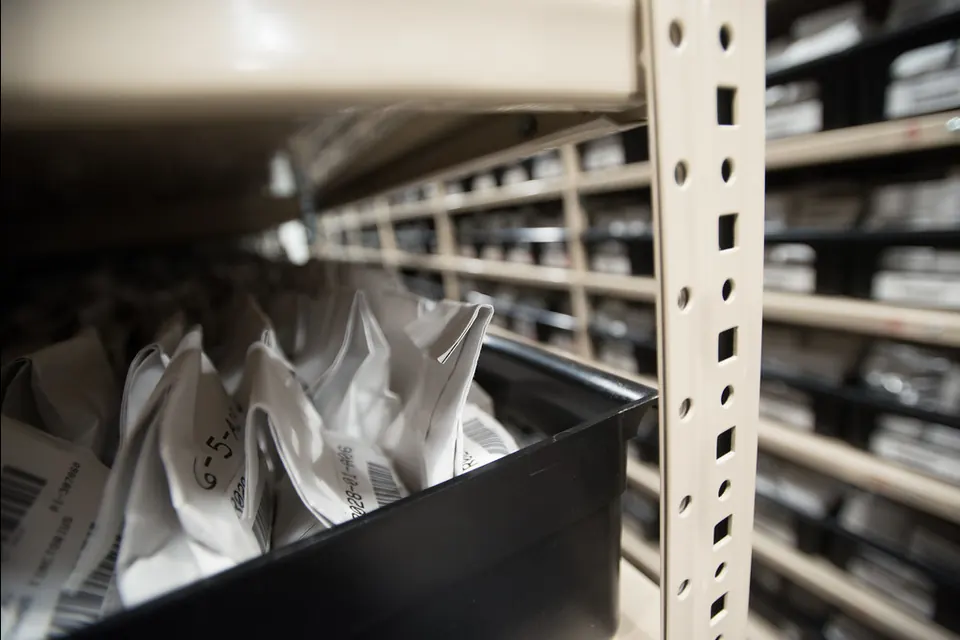
It is often called the "doomsday vault", and pictures of its concrete entrance sticking out of an Arctic hillside fit the nickname. The reality is more ordinary and more useful. The Svalbard Global Seed Vault is a spare copy: a place where genebanks around the world store duplicates of their seed collections, in case the originals are lost. It has already been used for exactly that purpose, after the war in Syria.
A freezer inside a mountain
The vault opened on 26 February 2008 near Longyearbyen, on the Norwegian archipelago of Svalbard. According to its official website, the storage area lies more than 100 metres inside the mountain, under 40 to 60 metres of rock. The idea of a global security store in Svalbard, the site adds, had been discussed since the 1980s.
The Crop Trust's description of the vault sets out the arrangement. The facility is owned by Norway and managed in partnership between the Norwegian Ministry of Agriculture and Food, the Nordic Genetic Resource Center (NordGen) and the Crop Trust, an international organisation that funds the conservation of crop diversity. NordGen operates the facility and maintains the public database of stored samples. The Crop Trust supports ongoing operations and pays for the preparation and shipping of seeds from developing countries. An international advisory council oversees management.
The figures given by the Crop Trust are simple: a capacity of 4.5 million seed samples, an average of about 500 seeds per sample, hence room for up to 2.5 billion seeds, kept at the -18 °C required for long-term seed storage.
A backup of a backup
The vault does not replace genebanks. It holds no primary collections, has no laboratory, does not multiply seeds and distributes nothing to breeders or farmers. It does not even have permanent staff on Svalbard: it opens on pre-arranged dates to receive deposits.
The conditions for depositors, published on the vault's website, make its role explicit. A depositing institution must:
- conserve the material as part of a long-term, sustainable genebank collection, with the capacity to multiply the seeds;
- certify that the samples are already safety-duplicated in another suitable genebank, which makes Svalbard the second backup;
- make samples available from its own stocks for breeding, research and education, on terms similar to those of the International Treaty on Plant Genetic Resources for Food and Agriculture and its Standard Material Transfer Agreement.
Storage is free. Depositors pay only for transport to Oslo airport and onward to Longyearbyen. Each deposit is covered by an agreement signed by the depositing institute and by NordGen on behalf of the Norwegian ministry.
The black box: Norway keeps the key, not the seeds
The legal arrangement explains why genebanks with very different interests trust the vault. Under what is usually called the black-box system, depositors keep ownership of their boxes, much like a safety deposit box in a bank. According to the Crop Trust, only the institution that deposited a box can withdraw it and open it. Norway provides the building and the cold, not access to the material.
This matters for countries and research centres that see their collections as national heritage or as material governed by benefit-sharing rules. The same logic of shared infrastructure without loss of control appears in other international research facilities described on this site, from GBIF, where institutions share data they continue to manage, to the SESAME synchrotron shared by governments that rarely cooperate elsewhere.
What is inside
The vault's official website displays a running count. On 16 November 2026 it showed 1,417,799 seed samples from 135 depositors, covering 6,587 species. Its page for the general public adds that the vault holds more than 250,000 types of wheat, 160,000 types of rice and 46,000 types of maize. The milestone of 1.4 million samples was announced in June 2026.
A sample, in genebank vocabulary, is an accession: seeds of one variety or population, collected or bred in one place, documented with its origin. Many are traditional varieties and wild relatives of crops, which carry traits such as drought or disease tolerance that breeders may need later. Why this diversity matters for food systems is discussed in our explainer on research and innovation in agri-food systems.
The test case: ICARDA and the war in Syria
The International Center for Agricultural Research in the Dry Areas (ICARDA) had its main genebank in Aleppo and had sent duplicates of its collections to Svalbard. When the Syrian civil war prevented it from maintaining the Aleppo genebank, it asked for its boxes back.
The Crop Trust describes the 2015 withdrawal as the first in the vault's history. A second, larger one followed. According to a Crop Trust news item of 13 September 2017, ICARDA withdrew 52,451 samples in 161 boxes: 68 boxes went to Lebanon for regeneration, including faba bean, wild barley and chickpea, and 95 boxes to Morocco, including bread wheat, durum wheat and lentils. The same article reports that more than 15,000 regenerated samples had been deposited back in February 2017 and more than 7,500 in September 2017, bringing about 78 percent of ICARDA's initial collection back to Svalbard.
The sequence shows how the system is meant to work. The seeds were not "used up": they were grown again in new fields, producing fresh seed for ICARDA's rebuilt genebanks, and new duplicates were returned to the vault. Between 2015 and 2019, according to the Crop Trust, the operation rebuilt the collections in Lebanon and Morocco.
Where the vault fits in the SDGs
Sustainable Development Goal 2 includes target 2.5, which calls for maintaining the genetic diversity of seeds, cultivated plants and farmed and domesticated animals and their wild relatives, including through soundly managed and diversified seed and plant banks at national, regional and international levels. The target carried a 2020 deadline, but its indicators, including the number of plant genetic resources secured in conservation facilities, remain part of the UN global indicator framework.
Svalbard is one piece of that system, and a dependent one. Its value rests on the genebanks that send the material: if a primary collection is badly documented, poorly stored or never regenerated, the duplicate in the Arctic inherits the same weaknesses. Seeds lose viability over time even at -18 °C, at different rates for different species, so a backup is useful only if the original institution is still able to test, regenerate and replace what it holds.
What the vault is not
- Not a public seed bank. Individuals cannot deposit or withdraw seeds; the vault's website directs people with valuable seeds to their nearest genebank, which can then place security copies in Svalbard.
- Not a place to visit. Only authorised personnel enter the vault; the public can take a 360-degree virtual tour online.
- Not a substitute for conservation in the field. Varieties kept by farmers keep adapting to local conditions; a frozen sample does not.
The vault's quiet success is a legal one as much as a technical one: 135 depositors trust a building in Norway because Norway has promised not to touch what is inside.
Sources
- Svalbard Global Seed Vault, official website of the Norwegian Ministry of Agriculture and Food, seedvault.no: home page counter, "About", "Depositors" and "For the general public" pages (opening date, location, depositor conditions, holdings; consulted 16 November 2026).
- Crop Trust, "Svalbard Global Seed Vault" (partnership, roles, capacity, storage temperature, black-box ownership, ICARDA withdrawals 2015 to 2019; consulted 16 November 2026).
- Crop Trust, "More than 50,000 seeds withdrawn from Seed Vault", 13 September 2017 (samples withdrawn, boxes sent to Lebanon and Morocco, samples returned).
 Cooperation and skills
Research and innovation in agri-food systems
Why food systems research is central to SDG 2, how international agricultural research is organised, and the trade-offs it raises.
 Research infrastructures
GBIF and open biodiversity data
An intergovernmental network that pools where and when species were recorded, what its 3.9 billion records contain, and what they miss.
 Research infrastructures
SESAME, a synchrotron in Jordan
How a light source in Allan works, who runs it, what scientists use it for, and why it matters beyond physics.