The Square Kilometre Array: how a telescope on two continents is built and run
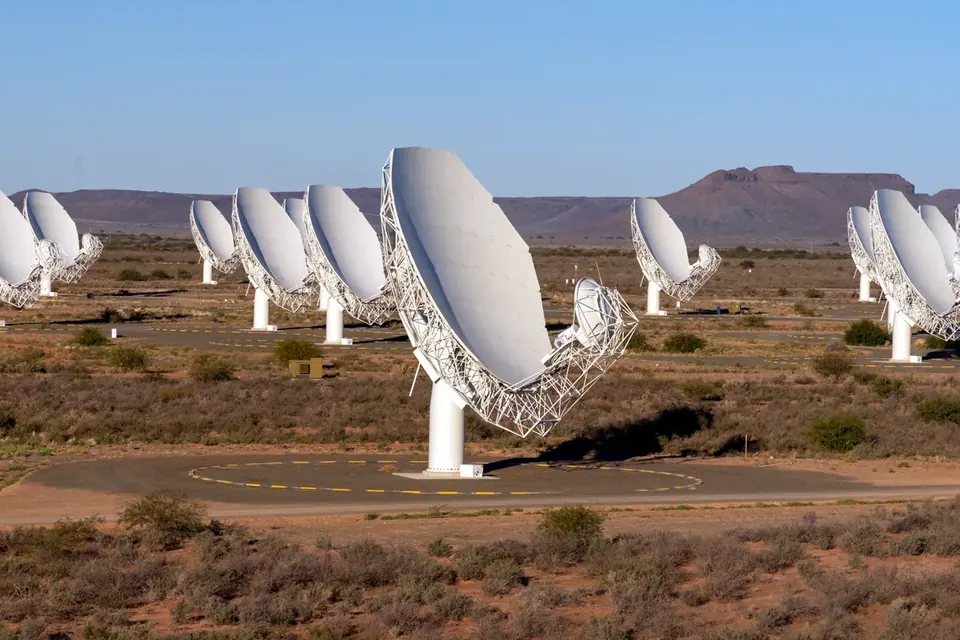
The Square Kilometre Array (SKA) is not one telescope but two radio telescope arrays on two continents, run by a single intergovernmental organisation. It is one of the clearest examples of what a "global research infrastructure" means in practice: a facility that no single country could justify alone, governed by treaty and shared by scientists worldwide.
What the SKA is
The project takes its name from an early ambition: a total collecting area of about one square kilometre of radio antennas. Rather than a single giant dish, radio astronomers combine signals from many antennas spread over large distances, a technique called interferometry. The wider the spread and the more antennas involved, the sharper and more sensitive the combined instrument becomes.
The SKA is built as two complementary arrays:
- SKA-Low, at the CSIRO Murchison Radio-astronomy Observatory in Western Australia, uses large numbers of small, fixed antennas that look like metal Christmas trees. They are grouped into stations and observe the lower radio frequencies.
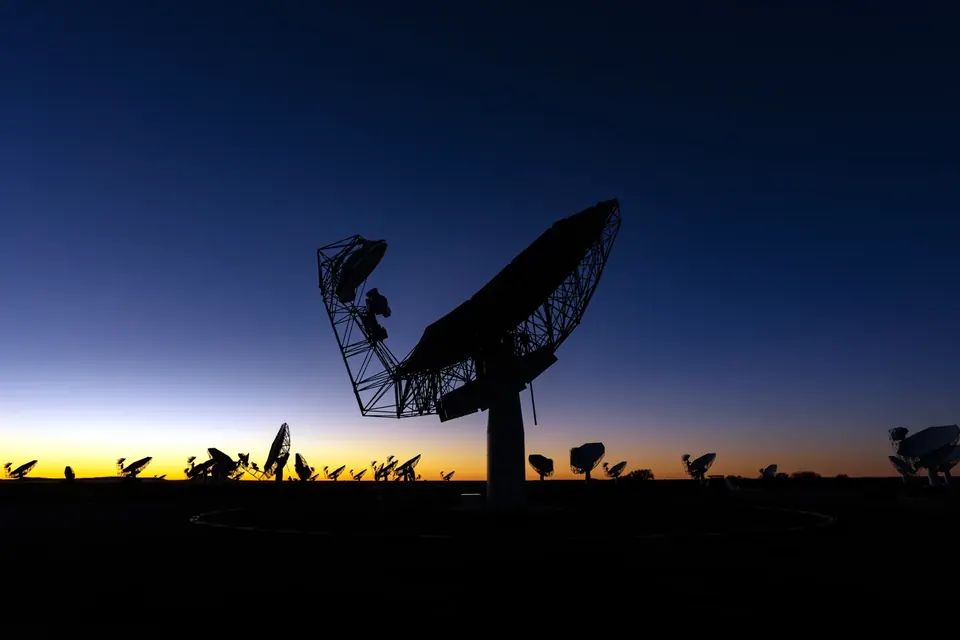
- SKA-Mid, near Carnarvon in the Northern Cape of South Africa, uses dish antennas for the mid-frequency range. It incorporates the existing MeerKAT telescope's 64 dishes, built by South Africa as a precursor instrument.
Both sites were chosen for their radio quietness: sparsely populated areas where mobile phones, broadcasting and other human-made signals are rare, and where national legislation protects the radio environment.
Who runs it: the SKA Observatory
The SKA Observatory (SKAO) describes itself as an intergovernmental organisation bringing together member countries to build and operate the telescopes. Its global headquarters is at Jodrell Bank in Cheshire, in the United Kingdom. Each telescope has a science operations centre (Perth for SKA-Low, Cape Town for SKA-Mid) and an engineering operations centre close to its site.
The organisation was created by an international treaty, the Convention establishing the Square Kilometre Array Observatory, signed in Rome in March 2019. It entered into force in January 2021 once enough signatories had ratified it. A treaty-based body matters for three reasons:
- Long-term commitment. Telescopes are designed to operate for decades. A treaty gives member states a stable legal framework for funding construction and operations beyond any single government's term.
- Legal personality. The observatory can sign contracts, employ staff and host facilities in several countries under a single set of rules.
- Fair return. Members expect a share of industrial contracts and scientific access proportionate to their contribution, a principle common to large European facilities such as CERN or ESO.
The SKAO Council approved the start of construction in July 2021, and on-site construction ceremonies were held in both host countries in December 2022. The arrays are built in stages, with intermediate "array assemblies" that let astronomers verify the system and do early science before the full design is complete. According to the SKAO's staged delivery plan, the stage known as AA* comprises 307 SKA-Low stations and a 144-dish SKA-Mid array (80 new SKA-Mid dishes plus the 64 MeerKAT dishes), with the further build-out depending on additional funding.
What it will study
Radio astronomy sees phenomena that optical telescopes cannot. The SKA's science case, developed by the international astronomy community, includes:
- The cosmic dawn. Faint radio signals from neutral hydrogen can trace how the first stars and galaxies formed and reionised the universe.
- Pulsars and gravity. Pulsars are extremely regular natural clocks. Timing many of them precisely allows tests of general relativity and the detection of low-frequency gravitational waves.
- Galaxy evolution and cosmic magnetism. Surveys of hydrogen gas and polarised emission show how galaxies gain and lose the fuel for star formation, and how magnetic fields arise.
- The cradle of life. Observations of planet-forming discs and complex molecules, and searches for technosignatures.
The data problem
An interferometer does not produce pictures directly. Signals from every antenna must be digitised, time-stamped with extreme precision, transported over long fibre links and correlated, pair by pair, in a supercomputer before they can be turned into images and catalogues. With thousands of antennas, the raw data rates are enormous, and the SKAO describes itself as a "big data" facility.
The consequence is organisational as much as technical. Data are reduced on site and in the operations centres, then distributed to a network of SKA Regional Centres hosted by member countries. Scientists will work on the data there rather than downloading it. That model only works if computing centres, software standards and access policies are coordinated internationally, which is why the SKA is often cited as a test case for shared scientific computing.
Why it appears in conversations about the SDGs
Astronomy is not one of the 17 goals, and claims that a telescope "delivers" the SDGs should be treated with care. The links are more specific than that:
| Area | Connection | Related SDG target |
|---|---|---|
| Skills and training | Engineering, data science and astronomy programmes built around the SKA and its precursors, notably in South Africa and partner countries in Africa | 4.4 (relevant skills), 9.5 (research capacity) |
| Industry and infrastructure | Contracts for antennas, fibre, power systems and computing; investment in remote-site infrastructure | 9.1, 9.5 |
| Partnerships | A treaty organisation pooling resources across continents | 17.6 (science and technology cooperation) |
| Energy and environment | Powering remote sites and supercomputers efficiently is a design constraint and a field of applied research | 7.3 (energy efficiency) |
There is also a question of fairness. Large facilities sited in the global South raise legitimate questions about who benefits: local communities near the sites, early-career researchers in host countries, and Indigenous custodians of the land. In Western Australia, for example, the SKA-Low site is on the traditional lands of the Wajarri Yamaji, and the observatory has an Indigenous Land Use Agreement for it. How such agreements work, and how benefits are shared, is a fair test of whether a global infrastructure is really global.
What the SKA teaches about global research infrastructures
- Governance comes first. Design studies started long before the treaty, but construction only began once a legal entity with committed members existed.
- Sites are a shared asset. Radio-quiet zones require national laws and local cooperation, not just land.
- Data infrastructure is half the project. Regional centres, software and open standards determine who can actually use the telescope.
- Staging reduces risk. Building in array assemblies lets problems surface early, at a fraction of the cost of the full system.
Further reading
- SKA Observatory, official website, including the members page and construction news.
- South African Radio Astronomy Observatory (SARAO), which operates MeerKAT.
- CSIRO Murchison Radio-astronomy Observatory, host of SKA-Low.
Related explainers: space technology and the SDGs, and LifeWatch ERIC, another treaty-based research infrastructure.
 Research infrastructures
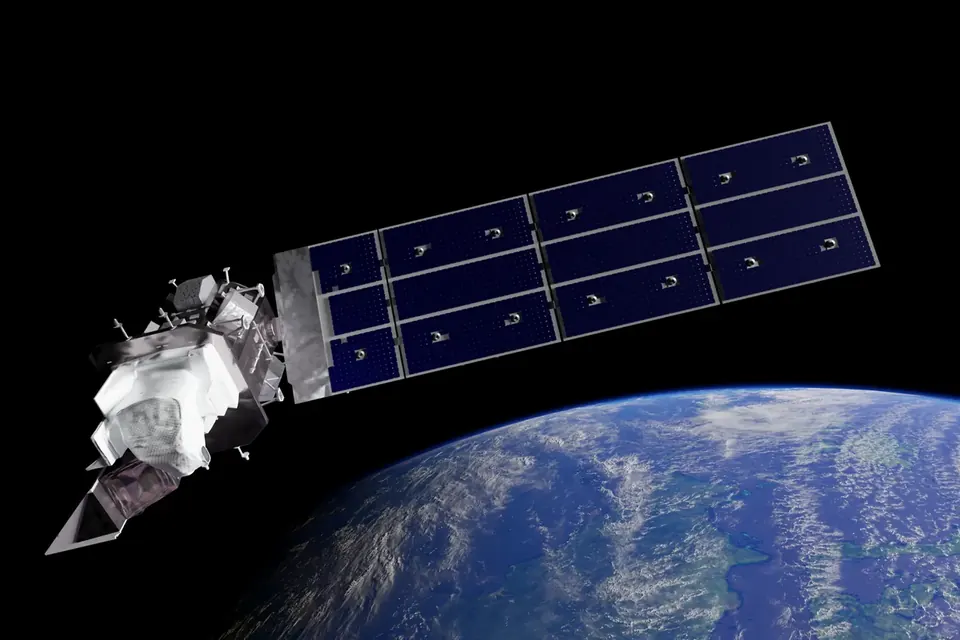
Space technology and the SDGs
Earth observation, navigation and communications satellites, the UN framework behind them, and the risks of crowded orbits.
 Research infrastructures
LifeWatch ERIC and biodiversity data
How a European research consortium gives ecologists shared data, models and virtual labs, and what that means for SDGs 14 and 15.
 Cooperation and skills
How the EU and the UN work together
The EU's status at the UN, Team Europe and Global Gateway, SDG reporting, research cooperation and the tensions worth knowing.